AI Governance: Why Companies Need a Step-by-Step Implementation Strategy

Artificial intelligence is no longer a future concept or a side experiment. It is here, and companies across every sector are racing to deploy AI tools in compliance, legal, finance, HR, procurement, cybersecurity, customer service, and operations. That creates opportunity, but it also creates risk. Too many organizations are approaching AI adoption with a mix of excitement, pressure, and improvisation. That is a mistake.
AI governance is not just a technical issue. It is a business, legal, compliance, and operational imperative. Companies that move too slowly may lose efficiency and competitive advantage. But companies that move too fast, without controls, may create serious exposure involving privacy, discrimination, consumer protection, data security, accuracy, explainability, and regulatory noncompliance. The answer is not to reject AI. The answer is to govern it carefully and implement it step-by-step.
A disciplined AI governance strategy begins with a simple truth: not every AI use case carries the same level of risk. Some uses are relatively low risk and can be deployed more quickly with sensible oversight. Others require extensive review, testing, legal analysis, and executive approval before launch. This is why companies need a staged implementation process rather than a broad, undefined push to “use AI everywhere.”
The first step is to identify and categorize proposed AI use cases. For example, using AI to summarize internal policies, organize large volumes of contracts, assist with invoice coding, or help draft routine internal reports may present a manageable level of risk. In contrast, using AI to screen job candidates, evaluate employee performance, approve customer accounts, monitor transactions for suspicious activity, or generate external statements to consumers or regulators presents significantly greater legal and reputational risk. Governance starts by recognizing these differences and applying controls accordingly.
The second step is to establish a cross-functional review structure. AI should never be deployed solely by IT, innovation teams, or eager business managers. Compliance, legal, privacy, information security, data governance, HR, and internal audit all need a seat at the table, depending on the use case. A cross-functional committee or review process can evaluate whether the AI tool uses sensitive data, whether outputs can be explained and validated, whether bias risks exist, whether vendor terms are adequate, and whether the tool may trigger industry-specific regulatory obligations.
Third, companies need to pilot AI tools in a controlled way before enterprise-wide deployment. This is one of the most important disciplines in AI governance. A pilot allows the organization to test performance, identify unexpected outputs, assess data integrity concerns, and understand where human review is necessary. In the compliance context, for example, AI may be useful in triaging hotline reports, identifying patterns in third-party due diligence files, or reviewing transactions for anomalies. But these tools should first be tested on limited data sets with clearly defined objectives and documented validation procedures.
This leads to the most important safeguard of all: human checkpoints. AI can accelerate review, identify patterns, and reduce repetitive work. It cannot be allowed to operate as an unchecked substitute for judgment, accountability, or legal responsibility. High-impact decisions must include human oversight. If AI flags a third party as high risk, a trained reviewer should assess the basis for that result. If AI identifies a suspicious transaction, a compliance analyst should evaluate whether the activity is truly anomalous. If AI is used in hiring or employee monitoring, HR and legal reviewers must validate that the process is fair, lawful, and supported by reliable data.
Human checkpoints are not a sign of mistrust in AI. They are an essential part of responsible implementation. AI models can hallucinate, overgeneralize, misread context, rely on flawed training data, or produce outputs that appear polished but are wrong. A company that removes human review in the name of efficiency is not creating innovation. It is creating unmanaged risk.
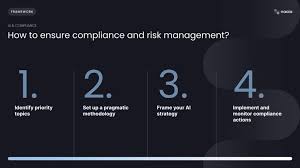
Effective AI governance also requires documentation and accountability. Companies should maintain an inventory of AI tools and use cases, identify data sources, assign business owners, define approval requirements, document testing, and track ongoing monitoring. Governance should include clear policies on acceptable use, restrictions on confidential or personal data inputs, vendor review standards, retention rules, and escalation procedures when AI errors or incidents occur.
Training is another critical component. Employees need practical guidance, not abstract principles. They should understand what tools are approved, what data may or may not be entered into AI systems, when human review is mandatory, and how to escalate concerns. Without training, even a well-designed governance framework will fail in practice.
The smartest companies are not treating AI governance as a barrier to innovation. They are treating it as the foundation for sustainable adoption. A step-by-step approach allows organizations to experiment intelligently, learn from pilots, improve controls, and expand use cases with confidence. It also helps demonstrate to regulators, customers, boards, and employees that the company is acting responsibly.
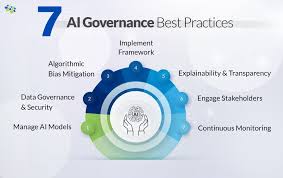
AI is too powerful to deploy casually and too valuable to ignore. That is why governance matters. Start with defined use cases. Rank risk. Use cross-functional review. Pilot carefully. Build in human checkpoints. Document decisions. Train employees. Monitor continuously. Companies that follow this roadmap will be in the best position to realize AI’s benefits while protecting themselves from the very real risks that come with it.