Nothing Crosses for Free: Understanding Cartel Control Over the U.S.-Mexico Border and Why Compliance Programs Need to Care (Part I of II)
There is a hard truth that compliance officers overseeing Mexico operations need to internalize, and it is the same truth prosecutors have started building into recent enforcement actions: at many points along the U.S.-Mexico border, cartels function as a de facto taxing authority. Goods, cash, and people do not move through certain crossings, ports, and corridors without someone, somewhere in that chain, paying a fee to a criminal organization that controls the territory. That is not a rhetorical flourish. It is the operating reality of the plaza system, and it is precisely the risk that recent Justice Department enforcement, including the FCPA resolution against The Scoular Company, has begun to formally recognize as a distinct and separate category of corporate exposure.
The Plaza System: Territorial Control as a Business Model
For decades, Mexican cartels have organized themselves around control of specific territories, commonly called plazas, that typically correspond to smuggling routes, ports of entry, and border crossings. Controlling a plaza means controlling the right to move contraband through it, but it also means controlling, or at minimum taxing, a much broader range of commercial activity that happens to pass through the same physical corridor. This is often referred to as piso, or derecho de piso, a toll charged for the right to operate, transport goods, or simply exist commercially within a cartel-controlled territory.
This taxing function is not limited to obviously illicit cargo. Legitimate commercial trucking, agricultural shipments, manufactured goods moving through maquiladora supply chains, and ordinary freight can all become subject to piso payments, extortion demands, or “protection” fees simply because they pass through a corridor a cartel controls. In many cases, these payments are not made directly by the shipping company at all. They are absorbed by intermediaries: customs brokers, freight forwarders, local trucking subcontractors, and warehouse operators, who build the cost of doing business in cartel territory into their own fees and pass it along, often without ever describing it accurately to the company that ultimately pays the bill.
Where Legitimate Fees and Criminal Payments Blur
This is where the compliance risk becomes acute. A legitimate business operating in Mexico expects to pay real costs: customs duties, inspection fees, warehousing charges, trucking tariffs, and administrative costs tied to cross-border logistics. Criminal organizations have learned to hide their extraction inside exactly these categories. A payment described as an expediting fee, a security charge, a reinspection fee, or a local handling cost can be entirely legitimate, or it can be a disguised bribe to a corrupt official, a direct payment to a cartel-connected broker, or some combination of both, flowing to entities that ultimately benefit organized criminal networks.

The Scoular case is instructive here precisely because it shows how ordinary this can look from the inside. Scoular’s customs brokers paid Mexican officials approximately $2,000 per train to clear agricultural shipments that had failed inspection, and invoiced those payments back to Scoular as reinspection fees. The government later determined that a portion of that bribe money ultimately benefited individuals associated with a cartel operating along the border, a fact Scoular itself did not know. The corporate liability did not depend on Scoular’s knowledge of the cartel connection. It depended on the existence of a bribery scheme that, once traced to its ultimate destination, touched a criminal network the company never intended to fund.
Why This Matters Now More Than Ever
Two developments have converged to make this a live compliance priority rather than a background risk. First, the government has formally designated major cartels as Foreign Terrorist Organizations, which activates material support liability under the Anti-Terrorism Act. That statute reaches money, goods, services, and transportation provided to a designated organization, and critically, it does not require the paying company to have known a cartel was involved at all. Second, prosecutors are now explicitly treating a demonstrated cartel nexus as an aggravating factor in enforcement actions that would otherwise be conventional bribery or fraud cases, as the Scoular resolution shows.
The practical effect is that a payment stream a company has always treated as an ordinary cost of doing business in Mexico, a customs fee, a trucking surcharge, a warehouse security charge, can now carry two layers of legal exposure stacked on top of each other: the underlying anti-corruption or fraud risk, and a separate, knowledge-independent risk that the money is ultimately reaching a designated criminal organization.
What Companies Operating Near the Border Need to Understand

Any company moving goods across the U.S.-Mexico border, whether directly or through intermediaries, should start from the assumption that certain corridors, ports, and crossings carry elevated cartel-related risk, and that this risk exists independently of whether any individual transaction looks suspicious on its face. The relevant question is not simply “does this invoice look legitimate,” but “do we actually understand the full chain of parties this payment passes through, and do we know whether any part of that chain operates under the influence, protection, or taxation of a criminal organization controlling this territory.”
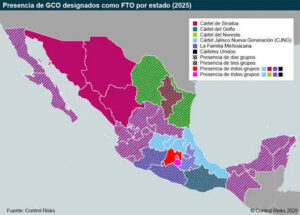
That requires a level of geographic and operational specificity that many compliance programs do not currently build into their risk assessments. It means knowing which crossings, ports, and transport corridors your goods actually move through, not just which country your operations are in. It means understanding whether your customs brokers, trucking subcontractors, and logistics partners operate in territories with known cartel presence, and whether their own cost structures reflect payments that cannot be explained by legitimate government fee schedules. And it means recognizing that a consistent, recurring, round-number payment, repeated transaction after transaction, is exactly the profile a cartel-linked extraction scheme is likely to produce, because criminal taxation, like legitimate taxation, tends to be systematic rather than random.
Part two of this series turns to the practical compliance response: how companies should be managing customs brokers, freight forwarders, and logistics providers operating in high-risk Mexico corridors, and what a compliance program needs to look like to credibly demonstrate, if ever asked, that it had the systems in place to catch this risk before a regulator did.