Caremark in 2026, Part 2: Boeing Supplies the Counterweight, and the Framework for Compliance Officers

Part 1 of this series looked at what the Teligent and Regions Financial cases teach about escalation and response under Delaware’s Caremark doctrine. In Part 2, we turn to the most significant recent Caremark development, the 2026 Boeing dismissal, and what the emerging doctrine means in practice for compliance officers building or defending an oversight program.
Boeing 2026: The Counterweight to Caremark’s Expansion
The most significant recent Caremark development arrived in August 2026, in a new round of Boeing litigation. This case arose from the January 2024 Alaska Airlines 737 MAX 9 incident, in which a door plug separated from the aircraft mid-flight. Stockholder plaintiffs alleged that Boeing’s directors and officers ignored numerous red flags involving manufacturing quality and airplane safety while pursuing production targets inconsistent with adequate safety and regulatory compliance. Given Boeing’s well-documented history with Caremark litigation following the earlier 737 MAX crashes, this looked, at least on its face, like a compelling case.
The Court of Chancery dismissed it anyway. The reasoning is the single most important part of this decision for anyone tracking Caremark doctrine: the question Caremark asks is whether fiduciaries consciously disregarded their oversight responsibilities, not whether their oversight efforts actually succeeded in preventing harm. The record showed extensive board and committee involvement in safety and quality issues, dedicated committees with responsibility for the relevant compliance risks, regular reporting to the board and its committees on safety, manufacturing, and quality, repeated director-level discussion of these issues, and ongoing management reporting on remediation efforts. Given that record, the court concluded the allegations simply didn’t support a reasonable inference of bad faith.
That’s a genuinely important distinction to sit with. A board can make mistakes. Remediation efforts can turn out to be inadequate. Compliance systems can fail to prevent serious misconduct, and serious regulatory violations can still happen. None of that, standing alone, establishes Caremark liability. The doctrine requires something more specific: an intentional dereliction of duty or a conscious disregard of known responsibilities. The 2026 Boeing decision functions as a real counterweight to the doctrine’s expansion over the past several years, and it’s a decision every board and compliance function should understand in detail.
If Everything Is a Red Flag, Nothing Is
Boeing also teaches a related and increasingly important lesson: there’s a growing tendency in Caremark litigation to characterize every negative piece of information a board receives as a red flag, and that approach threatens to collapse the distinction between oversight and day-to-day management entirely. Boards routinely receive information about operational problems, compliance weaknesses, audit findings, employee complaints, regulatory inquiries, and emerging risks as a matter of course, and the mere existence of that information often demonstrates that the reporting system is actually working as designed, not that it’s failing.

The Caremark question is more demanding than simply asking whether a board received negative information. It asks whether that information alerted directors to actual misconduct or a serious compliance threat requiring action, and whether directors then consciously disregarded that specific warning. A yellow flag isn’t automatically a red flag, and evidence that management is actively investigating and responding to a problem can actually undermine, rather than support, an inference of bad faith.
The Emerging Framework
Read together with Teligent and Regions Financial from Part 1, these cases sketch out a more mature and more precisely calibrated Caremark doctrine than existed even a couple of years ago. Marchand and the earlier Boeing litigation established that boards must build meaningful oversight of mission-critical risks. McDonald’s extended that oversight obligation to senior officers within their areas of responsibility. Teligent shows the real danger when mission-critical regulatory compliance systems allegedly break down at both the board and officer level simultaneously. Brewer highlights why meaningful action after serious allegations of illegality reach the board matters as much as the escalation itself. And the 2026 Boeing decision supplies the essential other half of the equation: when directors build real reporting mechanisms, actually receive the information those mechanisms generate, devote genuine attention to the relevant risk, and oversee responsive remediation efforts, Delaware courts will not impose Caremark liability simply because the company later experiences another crisis. Caremark is not becoming a generalized negligence standard for corporate governance, and if anything, recent decisions are sharpening rather than blurring the line between inadequate performance and actual bad faith.
What This Means for Compliance Officers
These decisions carry direct, practical implications for how compliance programs should be designed and documented. Mission-critical legal and regulatory risks need to be affirmatively identified and assigned clear ownership, and reporting protocols need to specify exactly what information reaches management, the relevant board committees, and the full board, and on what cadence. Serious allegations, particularly whistleblower complaints, regulatory findings, recurring violations, and evidence of potentially systemic misconduct, need defined escalation procedures that don’t stop at the moment of escalation.
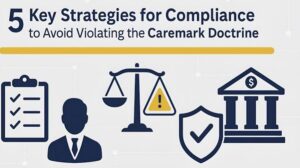
Just as importantly, escalation needs to trigger genuine follow-up. Boards need to be told not merely that a problem exists, but what’s actually being done about it, whether the remediation is working, and whether the underlying risk is increasing or decreasing over time. And the corporate records documenting that entire process, board minutes, committee reports, management updates, matter enormously. Stockholders increasingly use Delaware’s Section 220 books-and-records demand process before ever filing a Caremark claim, and as the 2026 Boeing decision shows, detailed records demonstrating sustained, genuine board engagement can become the single most powerful evidence against an inference of bad faith.
The Bottom Line
Caremark litigation isn’t going anywhere, and the range of risks that can generate it keeps expanding: cybersecurity, artificial intelligence, sanctions, anti-corruption, healthcare regulation, consumer protection, product safety, and workplace misconduct all present potential oversight exposure depending on a company’s specific business. But Delaware courts are not treating Caremark as strict liability for directors and officers whenever misconduct occurs somewhere in the organization. The doctrine that’s emerging points toward a practical, achievable governance standard: identify your company’s genuinely critical legal and compliance risks, build systems that reliably surface those risks, make sure the material information actually reaches the people responsible for acting on it, investigate credible warning signs, respond meaningfully to what you find, monitor whether remediation is actually working, and document the entire process along the way. Caremark does not demand that directors prevent every corporate failure. It demands a good-faith effort to oversee the risks that genuinely matter, and it demands that boards not consciously look away when serious compliance problems are staring them in the face.