The FTC Tells 24 Healthcare Giants That Complying With CMS Price Rules Is Not Enough

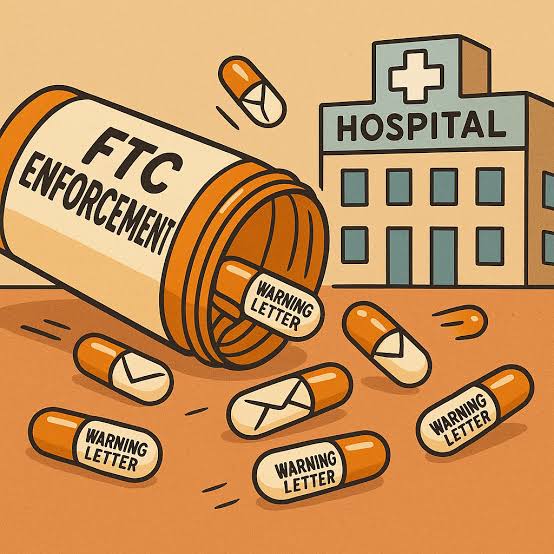
On October 5, the Federal Trade Commission sent warning letters to 24 of the nation’s largest healthcare services companies, telling them that they have a legal obligation to give patients timely, accurate, and complete pricing information, and that failing to do so can be an unfair or deceptive practice under Section 5 of the FTC Act. The agency did not name the recipients. But the legal theory in the letters is public, and it deserves attention from every compliance officer in healthcare, and from compliance officers in any industry where a customer is asked to commit before learning the full price.
What the FTC Said
The letters make several points, and the order in which they are made matters.
First, price is a material term. A patient deciding whether to schedule a procedure is entitled to know what it will cost, and the letters say that clear and conspicuous disclosures are often needed. Failing to disclose a price can be deceptive if the omission is likely to mislead consumers acting reasonably.
Second, disclosing some price information is not a defense if the disclosure is incomplete. The letters say a disclosure can still deceive when it leaves out physician fees or facility fees, or when it covers only part of the expected care, because a patient may reasonably believe that the number provided is the total cost. Inaccurate disclosures are equally misleading.
Third, the FTC advanced an unfairness theory in addition to a deception theory. Under Section 5, a practice is unfair when it causes or is likely to cause substantial injury that consumers cannot reasonably avoid and that is not outweighed by benefits to consumers or competition. The letters say that incomplete, inaccurate, or late price information, particularly for scheduled services where the provider can reasonably obtain the information in advance, prevents patients from comparing providers and making informed choices, and offers no offsetting benefit. The FTC also framed the harm as competitive: honest providers are disadvantaged when others obscure prices.
Fourth, and most important for compliance programs, the letters state that CMS price transparency rules are a regulatory floor, and that meeting them does not create a safe harbor under the FTC Act. A hospital can post a compliant machine-readable file and a compliant shoppable-services display and still face FTC liability if the numbers a patient actually sees before scheduling care are incomplete or misleading.
The FTC urged the recipients to conduct a comprehensive review of their price disclosure practices and to take swift corrective action as needed, and said it will continue to monitor the market and enforce as warranted. At an administration event announcing the letters, Chairman Andrew Ferguson went further, saying the letters are a warning, that providers must disclose prices starting now, and that the agency will take noncompliant providers to court. He also said the FTC has already opened law enforcement investigations into hospital price transparency.
The Context: CMS, the No Surprises Act, and a New Task Force
This did not come out of nowhere. The Centers for Medicare & Medicaid Services has been tightening hospital price transparency for several years. Updated requirements finalized in the 2026 outpatient payment rule became enforceable on April 1, 2026. They eliminated the “estimated allowed amount” placeholder that some hospitals had used, added data elements based on actual claims history, and required a senior official to attest in writing that the posted prices are true, accurate, and complete. Reporting this summer indicated that more than 500 hospitals received warning notices or requests for corrective action plans from CMS between April and early June, and an advocacy group’s review of about 2,000 hospitals found that fewer than half were in compliance. The same day as the FTC letters, the administration also announced a CMS final rule aimed at making required price data easier to use.

Separately, the No Surprises Act requires providers and facilities to give uninsured and self-pay patients a good faith estimate of expected charges for scheduled or requested services. And the FTC itself created a Healthcare Task Force earlier this year. In the week before the letters, it also sued an online contact lens seller over alleged misrepresentation of prices in search ads and on its website. The agency is applying a familiar principle, that advertised and quoted prices must be real, to a sector where prices have historically been opaque.
Why the “No Safe Harbor” Point Changes the Compliance Equation
Healthcare compliance programs have been built around the CMS rule: post the file, update it annually, build the shoppable services tool, attest. That work remains necessary, and CMS enforcement is increasing. But the FTC’s position changes what “compliant” means for a hospital’s patient-facing practices.
The test under Section 5 is not whether the hospital met a checklist. It is what a reasonable patient would conclude from what the hospital told them. If a scheduling representative or an online estimator gives a number that covers only the facility charge, and the patient later receives a separate bill from a physician group or an anesthesiology practice, the question is whether the first number led the patient to believe it was the total. If the hospital knew, or could readily have known, about the additional charges, the FTC’s theory is that the incomplete disclosure is deceptive and the omission is unfair.
That has particular implications for the most common healthcare billing structure, in which the hospital bills for the facility, and independent physician groups bill separately for professional services. A hospital’s price estimate that stops at the facility fee may be technically accurate and still misleading. The letters put hospitals on notice that they cannot treat the separate billing arrangement as an excuse if they are the entity patients rely on for the quote.
What Compliance Officers Should Do Now
The letters ask for a review. Here is how I would structure it.
Map every channel through which a patient receives a price or estimate. That includes the website estimator, the scheduling call center, financial counselors, pre-registration paperwork, patient portal, text messages, and any good faith estimate for self-pay patients. A review limited to the machine-readable file will miss most of what the FTC is talking about.
Test what patients are actually told. Mystery-shop scheduled, non-emergency procedures. Compare the quoted number to the final bill and to the total expected cost, including physician and facility fees and related services. Document the gaps.
Close the professional fee gap. If independent physicians or groups bill separately, decide how the hospital will disclose or at least clearly flag those charges, including what the estimate does and does not include, and coordinate with those groups to obtain their pricing where feasible.
Check the language. If a quote covers only part of the expected course of care, say so prominently. Avoid phrases like “your cost” or “total” unless they are accurate. Disclaimers buried in fine print are unlikely to cure a misleading headline number, as the FTC’s long-standing approach to clear and conspicuous disclosures suggests.
Integrate the FTC lens into governance. Price transparency is currently a regulatory compliance function in many systems, owned by revenue cycle or by compliance. It should also be reviewed as a consumer protection matter, with legal, marketing, patient access, and revenue cycle at the table, and with reporting to the board or compliance committee. The CMS attestation process, in which a senior official certifies accuracy, is a useful model for internal accountability.
Fix the root causes and preserve the record. If your review finds problems, correct them promptly and document what you found and what you changed. Companies that identify and remedy issues before an investigation begins are in a stronger position than those that wait.
And do not assume your organization is outside the letters’ reach because you were not on the recipient list. The FTC chose 24 of the largest companies as a signal. The legal theory applies to any provider that quotes prices to patients.
Bottom Line
For years, price transparency has been framed as a data-publication obligation. The FTC’s letters reframe it as a truth-in-advertising obligation that runs to each patient at the moment of decision. A hospital can satisfy the first and fail the second. The agencies are now enforcing on both tracks, and the safest course is to build a program that answers both questions: did we publish what CMS requires, and does what we told this patient give them an accurate picture of what they will pay.